
What Happens When a Supernova Leaves Behind a Black Hole?
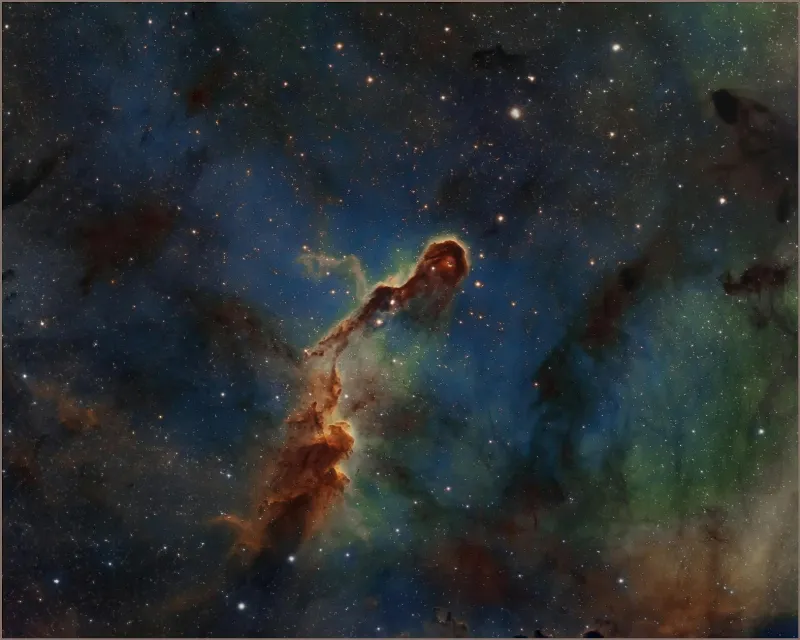

The Cosmic Catastrophe You Didn't Know About
Imagine a star so massive that when it dies, it doesn’t just fade away. It explodes. This explosion, known as a supernova, is one of the most spectacular events in the universe. But what happens next? What if I told you that some supernovae leave behind a black hole? It’s true, and the implications are mind-boggling.
From Star to Silence
A supernova occurs when a star has exhausted its nuclear fuel. It can’t hold itself together anymore. The core collapses under gravity, and the outer layers explode outward, creating a brilliant light that can outshine entire galaxies. But some remnants? They’re not just empty shells. They collapse further into a black hole, a point in space where gravity is so strong that nothing, not even light, can escape.
Why does this matter? Because black holes are gateways to understanding the very fabric of our universe. They're not just cosmic leftovers; they're key players in the cosmic drama.
The Birth of a Black Hole
When a supernova leaves behind a black hole, it’s like a magician performing an incredible trick. One moment, you have a star. The next, poof! It’s gone. The core that remains after the explosion can become incredibly dense, more than you can imagine. A mass greater than that of our Sun crammed into a space so small it’s almost incomprehensible.
What Lies Beyond the Event Horizon?
Now, here’s where it gets interesting. The edge of a black hole is called the event horizon. Cross it, and you’re lost to the universe. No signals, no light, nothing. It’s a one-way trip. But what’s on the other side? That’s the million-dollar question. Some scientists believe it could lead to another universe, while others think it may simply be a point of no return.
The Role of Black Holes in the Universe
Black holes aren’t just cosmic vacuum cleaners. They play a vital role in the formation of galaxies. They can influence star formation and the movement of galaxies. Their gravitational pull can attract surrounding matter, forming accretion disks that radiate energy and heat. This energy can sometimes lead to the formation of new stars.
In a way, black holes are the universe’s recycling centers. They consume and transform matter, contributing to the cosmic cycle of creation and destruction.
Unraveling the Mysteries
Despite their importance, black holes remain one of the universe's greatest mysteries. The study of these enigmatic entities challenges our understanding of physics. General relativity versus quantum mechanics? Black holes sit at the intersection of these two worlds, creating a cosmic puzzle that scientists are racing to solve.
Recent advancements in technology, like the Event Horizon Telescope, have allowed us to capture images of black holes. This groundbreaking work gives us a glimpse into these dark giants and the phenomena surrounding them.
The Future of Black Hole Research
As we continue to explore the cosmos, black holes will undoubtedly remain at the forefront of astronomical research. Every discovery offers a new piece of the puzzle. We’re learning that these cosmic phenomena are more than just remnants of stars; they are fundamental to the very structure of our universe.
So, what happens when a supernova leaves behind a black hole? We’re only beginning to understand. As we peel back the layers of this cosmic mystery, we may find answers to questions we haven’t even thought to ask yet.
Hungry for more?
Explore thousands of insights across all categories.
