
What Happens When a Black Hole Collides with Another Black Hole?
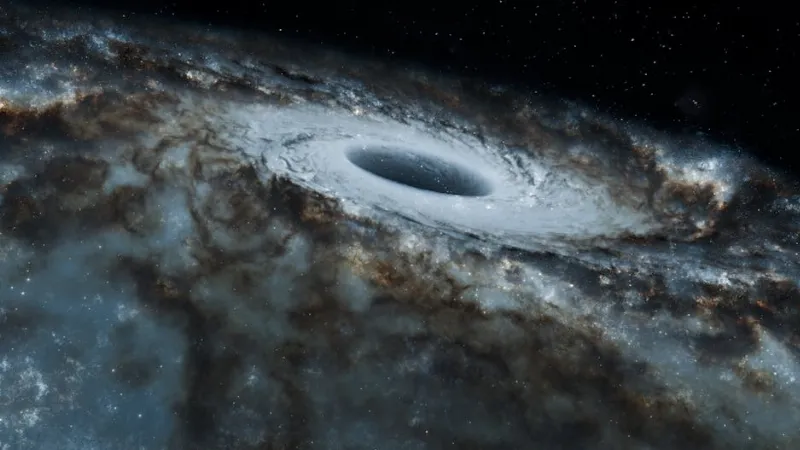

When Giants Clash: The Dance of Black Holes
Imagine a cosmic ballet, where two of the universe's most enigmatic entities, black holes, spiral around each other, drawn together by their immense gravitational pull. This is no ordinary dance; it’s a spectacular cosmic event that can lead to one of the universe's most profound phenomena: a black hole collision.
Whispers in the Cosmos: The Birth of Gravitational Waves
As two black holes approach one another, the fabric of spacetime itself seems to shudder. Their gravitational fields stretch and twist the very essence of reality around them. When they finally collide, the event generates ripples in spacetime known as gravitational waves. These waves are like sound waves but in the cosmic scale, traveling at the speed of light and carrying information about their origins.
The first detection of gravitational waves in 2015 by LIGO was a game-changer for astrophysics. It confirmed a major prediction of Einstein's general theory of relativity and opened a new window into observing the universe. Each collision sends powerful waves that can be detected by sensitive instruments here on Earth. It’s like tuning into the universe’s grand symphony, with each collision composing a unique note.
From Two to One: Creating Larger Black Holes
But what happens after the waves pass? The two black holes merge to form a larger black hole, a celestial heavyweight that can have a mass several times greater than that of our Sun. This new entity often spins with a ferocity that is astonishing, leading to even more complex gravitational waves that scientists continue to study.
NASA and other space agencies are keenly interested in these mergers because they provide vital clues about the life cycles of black holes, stellar evolution, and the dynamics of our universe. Each merger tells us a little more about how black holes grow and evolve over time, revealing the hidden processes that govern the cosmos.
The Cosmic Playground: Where Do These Events Happen?
Black hole collisions primarily occur in regions of space where galaxies interact or collide. These cosmic neighborhoods are bustling with activity. Think of them as crowded cities in the universe, teeming with the potential for chaos and creation. Here, black holes can capture stars and gas, increasing their mass and influence.
Interestingly, the conditions that lead to black hole mergers can take millions of years to develop. Yet, when they do occur, they unleash energy equivalent to several times that of our Sun over the course of a few seconds. It’s a dramatic reminder that the universe rarely keeps still.
Listening to the Universe: The Future of Black Hole Research
As technology advances, our ability to detect and analyze gravitational waves improves. Future observatories, like the planned space-based LISA (Laser Interferometer Space Antenna), promise to enhance our understanding of these cosmic collisions. With each discovery, we peel back layers of mystery surrounding black holes.
What’s fascinating is how these events connect to the fundamental questions of existence. How did the universe form? What lies at the heart of a black hole? The collision of black holes may not just reshape their own destinies but could also illuminate the very fabric of reality itself.
The Cosmic Ripple Effect: Understanding Our Place in the Universe
When black holes collide, they don’t just reshape their own fates; they alter our understanding of the universe at large. Gravitational waves serve as a bridge to the past, allowing us to explore events that happened billions of years ago, long before humanity gazed up at the stars. Each collision is a story waiting to be told, a reminder of the dynamic and ever-evolving nature of space.
As we continue to listen to these cosmic echoes, we gain insight not just into black holes, but into the very nature of existence. The universe is full of mysteries, and with each collision, we move one step closer to unraveling them.
Hungry for more?
Explore thousands of insights across all categories.
