
Mysterious cosmic signals: What recent data from the CHIME telescope reveals about fast radio bursts
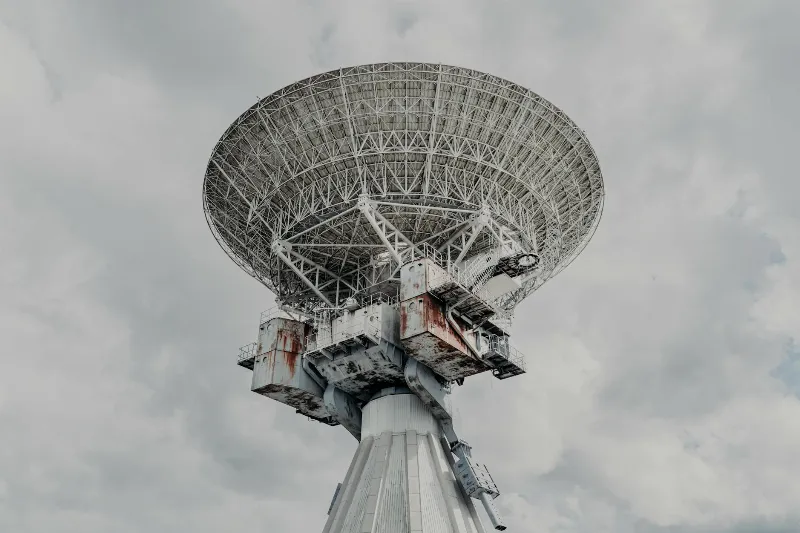

Fast Radio Bursts: A Cosmic Enigma
Fast radio bursts (FRBs) are among the most intriguing phenomena in astrophysics. These short, intense bursts of radio frequency emissions last only milliseconds but pack immense energy, equivalent to what the sun emits in days.
CHIME's Groundbreaking Observations
The Canadian Hydrogen Intensity Mapping Experiment (CHIME) telescope, operational since 2017, has significantly advanced our understanding of FRBs. It has detected more than 1,000 bursts, a staggering increase compared to earlier discoveries. CHIME's wide-field view allows it to capture a large volume of the sky, leading to a multitude of findings.
“CHIME has revolutionized our approach to studying FRBs, revealing patterns that were previously indistinguishable.”
New Patterns and Insights
- Repeating FRBs: CHIME has identified FRBs that repeat, allowing scientists to study them more closely. For instance, FRB 121102, discovered in 2012, has been observed to emit bursts regularly.
- Polarization: Recent data indicates that some bursts are highly polarized, suggesting a complex interaction with their surrounding environments.
- Location and Distance: Many bursts detected by CHIME originate from distant galaxies, often billions of light-years away.
Implications for Astrophysics
Imagine this: each FRB might not just be a random cosmic event but rather a signature of a larger astrophysical process. Understanding these signals could unlock secrets about the universe’s evolution, the nature of dark matter, and even the formation of galaxies.
Challenges Ahead
Despite the advancements, significant challenges remain. The exact mechanisms behind FRBs are still unknown. Are they caused by neutron stars, black holes, or something even more exotic? As researchers sift through the data, the puzzle intensifies.
Future Directions
The future of FRB research hinges on collaboration and technological advancements. Upcoming telescopes and upgrades to existing facilities will enhance our ability to detect and analyze these signals. For example, the Square Kilometre Array (SKA) promises to revolutionize how we study the radio sky.
Conclusion? Not Quite!
As we delve deeper into the mysteries of the universe, fast radio bursts remain a focal point of research. Each breakthrough not only challenges our current understanding but also ignites the curiosity of scientists and enthusiasts alike. FRBs are more than just signals; they are cosmic messengers urging us to explore further.
Hungry for more?
Explore thousands of insights across all categories.
